
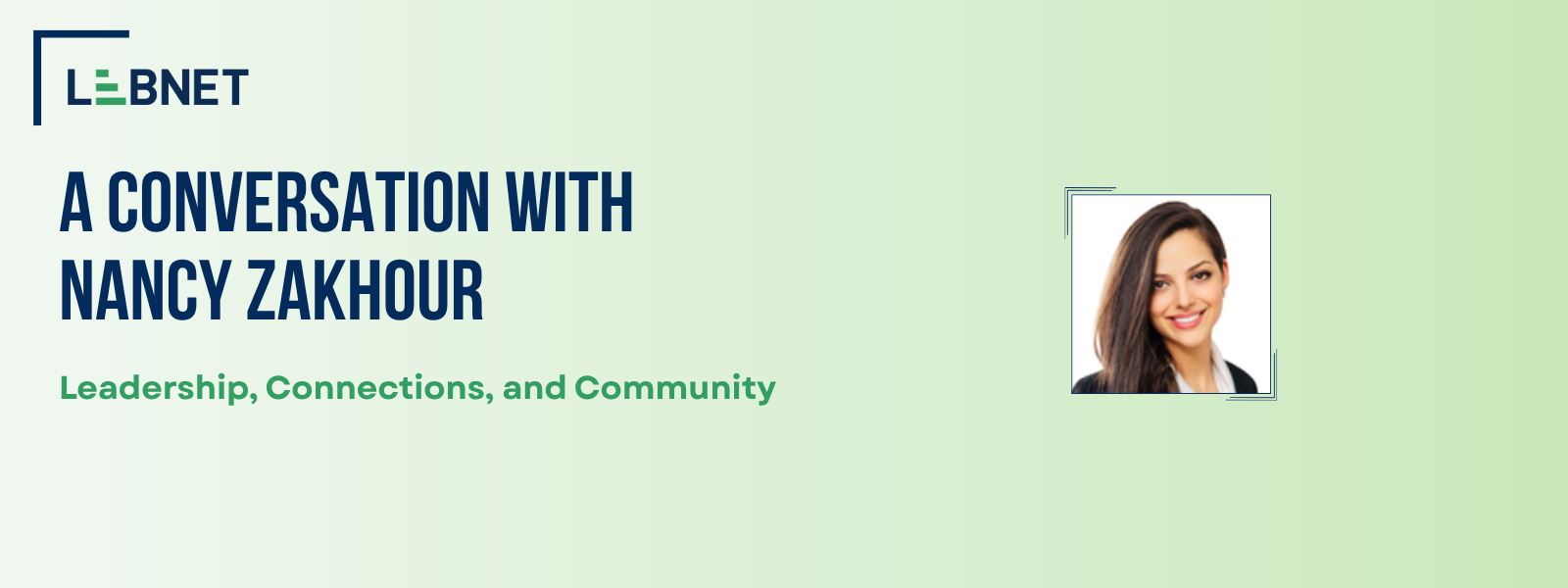
Leadership, Connections, and Community: A Conversation with Nancy Zakhour
 At a Glance
Organization: MorpheusOS
Role: Co-Founder & Chief Commercial Officer
Industry: Software Development
LebNet Connection: Houston Community Lead
From working as a field engineer across four continents to leading commercial initiatives in energy and technology, Nancy Zakhour has built a career defined by curiosity, adaptability, and a willingness to embrace new challenges.
Today, as Co-Founder and Chief Commercial Officer of MorpheusOS, Nancy brings her experience across engineering, business, and leadership to the evolving world of artificial intelligence. Beyond her professional achievements, she is also a children's book author and an active contributor to the Lebanese professional community.
As LebNet's Houston Community Lead and an early supporter of its Women in Tech Community, Nancy believes in the power of meaningful connections, mentorship, and creating opportunities for others.
In this month's LebNet Spotlight, Nancy reflects on her professional journey, the lessons that have shaped her leadership approach, her passion for storytelling, and her commitment to strengthening the Lebanese diaspora community.
A Career Across Energy and Technology
Your professional background spans engineering, energy, and technology, with experience in both technical and leadership roles. How has your career evolved, and what experiences have most shaped the way you approach leadership and professional growth?
I began my career as a field engineer, working across India, Egypt, Malaysia, and Russia, and later in the United States, including West Texas, South Texas, and the Northeast. Those experiences shaped me in ways a classroom never could. Working across different cultures and operating environments taught me to listen, adapt, and appreciate how much you can learn from the people beside you, especially those closest to the work.
Over time, my career expanded into business development, investment banking, and commercial leadership across oil and gas, low carbon ventures, and renewable energy. Each transition broadened my perspective. I learned that a strong technical solution is only one part of the equation. It also needs to make financial sense, address a real need, and be something a team can deliver. Moving between those worlds has shaped how I approach leadership: connecting different perspectives, asking questions, and helping people understand how their contributions fit into the larger picture.
Today, alongside serving on a public company board and advising companies across energy, infrastructure, and technology, I am building MorpheusOS as its Co-Founder and Chief Commercial Officer. MorpheusOS is an AI operating layer that helps businesses preserve the knowledge, decisions, and context that can so easily get lost across people and systems, and put that knowledge to work. Our approach places governance, security, and human accountability at the foundation, with clear permissions, traceable decisions, and oversight of what AI is authorized to do. For me, it brings together many of the challenges I have encountered throughout my career: how to help organizations move faster without losing the judgment, knowledge, and controls they depend on.
What has stayed consistent is a willingness to be a beginner again and to accept that growth comes with failure. Some of the most valuable lessons come from taking on something unfamiliar, getting parts of it wrong, and being honest enough to learn from the experience. I bring my experience with me, but I know I do not have all the answers. I am fortunate to be surrounded by phenomenal people, and I am always looking to learn from them. To me, leadership is not about having the answer to every question. It is about creating an environment where people can contribute, challenge one another thoughtfully, and find a better answer together.
Beyond Engineering
Alongside your career in energy and technology, you're also a children's book author. What inspired you to explore writing, and how does that creative side of your life connect with your professional experiences, if at all?
My father was a gifted storyteller, and that is where the inspiration began. He showed me that the art of storytelling is not simply in recounting what happened, but in making someone feel part of it. Writing children’s books became a way to carry those stories forward and pay tribute to my parents and grandparents. Through Elissa Discovers, I can share pieces of our culture with children in a way that invites curiosity and conversation.
There is something very meaningful about giving a child a story that helps them connect with where they come from, or discover a world different from their own. Stories give traditions and memories a life beyond the people who first shared them. They turn something we want to preserve into something another generation can feel connected to and make their own.
Writing may seem far removed from engineering, but I see a connection. Both ask you to be curious, pay attention, and make something understandable. In my professional life, I often need to explain a complicated idea to people with very different perspectives. The art of storytelling is finding the thread that helps them see not just how something works, but why it matters. That is an important part of leadership too: giving people a sense of purpose and helping them see their place in what you are building together. Writing for children reminds me that clarity takes work, and that a story can reach someone in a way an explanation alone sometimes cannot.
Women in Technology and Leadership
You were part of the first leadership team that helped launch LebNet's Women in Tech (WiT) Community. What motivated you to get involved at that early stage, and what challenges or opportunities did you recognize for women working in technology?
I wanted to help create the kind of community where women could have honest conversations about their careers, not just share the polished version of how things were going. There is real value in being able to ask someone how they navigated a difficult decision, negotiated an opportunity, or found their way into leadership.
A great deal of my inspiration came from LebNet’s Executive Director, Jeanine Akiki, who truly put these principles into practice. Supporting this initiative and working more closely with her allowed me to witness firsthand what it means to create opportunities for others, not simply encourage them from a distance. Seeing the care and intention she brought to that work was deeply inspiring and reinforced the kind of community I wanted to help build.
Being involved early meant we could help shape that space together. I wanted it to be useful to women at different stages, whether they were starting their first job, considering a career change, or taking on greater responsibility.
What mattered to me was going beyond encouragement. Encouragement is important, but so are introductions, candid feedback, and people who will put your name forward when an opportunity comes up. Jeanine’s example made that distinction very real for me. That is where a professional community can make a tangible difference: helping turn talent and ambition into access, and a sense of belonging into the confidence to take the next step.
Drawing on your own experience in engineering and technology, what barriers have you encountered or witnessed for women pursuing technical and leadership roles, and what do you believe needs to change?
One challenge women can experience in technical fields is the feeling that they need to do more to demonstrate their readiness for the next opportunity. Preparation and strong performance are important, but so is having people who recognize your potential and encourage you to step forward before you feel you have every answer. That is where thoughtful leadership and a supportive professional community can make a meaningful difference.
I believe we can make greater progress by being intentional about how we develop talent. Giving women opportunities to lead challenging projects, gain exposure to different parts of a business, and contribute to consequential decisions helps build both confidence and a record of leadership. Clear expectations and candid feedback make that growth more accessible.
Women also have an important role in supporting one another. Sharing what we have learned, recognizing each other’s contributions, making introductions, and putting someone’s name forward are practical ways to create opportunity. Equally valuable are relationships where we can speak openly about uncertainty, ask for guidance, and learn from setbacks. We do not need to have reached a particular title or level of seniority to be helpful to someone else.
There are many women and men already setting a wonderful example through mentorship and sponsorship. Building on that example means making support a consistent part of how we lead, rather than something that happens by chance. The opportunity is to create workplaces and professional communities where high standards are matched by meaningful investment in people, and where more women can see a path to leadership and help others follow.
Rebuilding the Houston Community
You've played a central role in revitalizing the LebNet Houston Community, bringing together a new leadership team and encouraging greater participation. What motivated you to take on this initiative, and what do you hope to achieve through the community?
LebNet is exactly what Houston needs: a community grounded in technical expertise and committed to helping people translate that expertise into opportunity and impact. Houston brings together extraordinary talent across energy, technology, healthcare, and entrepreneurship. LebNet can connect that talent across disciplines and generations, creating a stronger fabric through which Lebanese professionals contribute to one another’s success and to the broader community.
The motivation to help revitalize LebNet Houston came from recognizing how much becomes possible when those connections are intentional. Technical excellence deserves an environment that nurtures it through mentorship, career development, and access to people who can help turn ambition into meaningful progress. For entrepreneurs, that means more than encouragement. It means investing time, expertise, and relationships in their efforts, helping them navigate difficult decisions, and taking a genuine stake in their success.
Building that environment is a collective undertaking. Our leadership team brings different experiences and networks, allowing us to reach beyond familiar circles and create a community where established leaders, emerging professionals, and founders can learn from and support one another. The strength of that community will come not simply from whom we bring together, but from how consistently we show up for each other.
The ambition is to build something that endures beyond individual events or introductions. When expertise is shared, careers are strengthened, and entrepreneurs are supported, the benefits extend well beyond the original connection. Those who receive support become mentors, collaborators, and advocates for others. That is the compounding effect we hope to create: a community whose technical depth and shared commitment generate opportunities, strengthen Houston, and leave a lasting foundation for generations to come.
Staying Connected and Giving Back
Having built a career across energy and technology while remaining actively involved in the Lebanese professional community, what does giving back to Lebanon mean to you, and where do you see opportunities for the diaspora to make a meaningful difference?
Giving back to Lebanon means sustaining a connection that carries responsibility as well as affection. So many Lebanese people already embody that commitment through their generosity, mentorship, entrepreneurship, and quiet dedication to helping others succeed. There are remarkable examples to learn from and follow, often people who ask for little recognition but remain steadfast in what they contribute. Their example is both an inspiration and a reminder that each of us has something valuable to offer.
The diaspora is particularly well positioned to connect Lebanese talent with international markets, customers, investment, and professional networks. We can help entrepreneurs reach their first clients, support young professionals as they develop their careers, and create opportunities for people in Lebanon to contribute their expertise to work with global reach. Not every contribution needs to be a large initiative. A thoughtful introduction, candid guidance, or time invested in someone’s aspirations can have a lasting influence.
That work requires humility and attentiveness. Living abroad does not give us a clearer understanding of what people in Lebanon need. Meaningful engagement begins with listening, respecting the knowledge and initiative of those on the ground, and following through on the commitments we make. The strongest partnerships recognize that we have as much to learn as we have to contribute.
The opportunity is to build on the generosity that already exists and make those efforts more connected and enduring. Giving back can be woven into how we live and work, not only as a response to crisis, but as a sustained investment in people and their potential. When those who benefit from an opportunity extend that same support to others, the impact compounds, strengthening a tradition of mutual support that can serve generations to come.